The Yerevan Pivot: Armenia and EU Formalize Strategic Shift Amid Russian Security Vacuum
As the first-ever EU-Armenia Summit convenes in Yerevan, Prime Minister Pashinyan bets on European institutional anchors to replace a fractured Russian alliance ahead of pivotal June elections.

Y
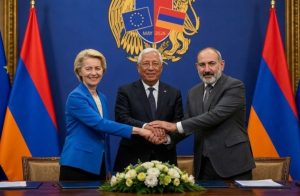
EREVAN, Armenia — In a historic realignment of power in the South Caucasus, the European Union and Armenia launched their first-ever bilateral summit in Yerevan on Monday, signaling a definitive end to Armenia’s decades-long reliance on Moscow and the formalization of a new strategic “foothold” for the West. The two-day summit, running May 4–5, 2026, coincides with the 8th European Political Community (EPC) gathering, effectively transforming the Armenian capital into a hub for Western diplomacy.
The high-level talks, attended by European Commission President Ursula von der Leyen and European Council President António Costa, follow years of deteriorating relations between Yerevan and the Kremlin. This shift was accelerated by what Armenian officials describe as Russia’s “strategic abandonment” during the 2020 and 2023 Nagorno-Karabakh conflicts, where Russian peacekeepers and the CSTO military alliance failed to intervene against Azerbaijani advances.
A central pillar of the partnership highlighted at the summit is the €135 million financing agreement originally signed on March 19, 2026. This investment in the Caucasus Transmission Network—supported by the EU and Germany—is designed to decouple Armenia’s power grid from Russian energy dominance. By routing through Georgia to integrate with the broader South Caucasus and European systems, the project aims to scale up renewables and make Russian gas less of a political lever against Yerevan.
ALSO READ: The Two Brazils: Lula and Flávio Bolsonaro Locked in Statistical Tie Ahead of 2026 Vote
Security and border sovereignty have also taken a formal leap forward. Beyond the EU Partnership Mission (EUPM) established on April 21, 2026, to counter disinformation ahead of the June 2026 elections, leaders today witnessed a significant deepening of ties with Frontex. Building on an initial 2021 agreement, the new working arrangement scales up technical cooperation to modernize Armenia’s border management independently of historical Russian oversight.
Armenia is currently navigating a dangerous ‘security twilight zone.’ While the EU is offering institutional anchors, the lack of a ‘hard’ military guarantee means Yerevan is betting its survival on the hope that Western diplomatic presence can deter regional aggression.
Prime Minister Nikol Pashinyan’s “geopolitical heart transplant” remains a high-stakes gamble that has deeply polarized the nation. Critics and opposition leaders argue that by distancing the country from traditional allies Russia and Iran, Pashinyan has left Armenia vulnerable. Opponents frequently cite the 2022 Prague Declaration as a tactical blunder that provided Moscow a legal pretext to withhold military aid, a move the opposition labels as a betrayal of the ethnic Armenian population.
ALSO READ: Mali Accuses Western Media of “Psychological Warfare” as Russia Deepens Sahel Influence
Beijing Defies Washington: China Issues Historic “Blocking Order” Over Iranian Oil Sanctions
The regional stakes are further complicated by Tehran. Iran’s primary “red line” remains the TRIPP corridor (Trump Route for International Peace and Prosperity), a transit project that Iran fears could bypass its territory and compromise its strategic link to Armenia.
In Baku, the reaction to the Yerevan summit has been one of sharp condemnation, with officials characterizing the EU’s role as “destabilizing.” Despite the fragile baseline for peace established by the joint declaration initialed at the White House on August 8, 2025, significant security gaps remain. The upcoming polls will determine if the Armenian electorate believes European institutional support can provide a more sustainable future than the fractured security alliances of the past.
While the EU provides “soft power” and economic integration, Russia still maintains its 102nd Military Base in Gyumri. The transition period represents a delicate balancing act for a nation attempting to redefine its place in the world while surrounded by traditional, often hostile, regional powers.
Living Faith
Crusade 2026
Experience Three Powerful Days of Faith, Worship, and God's Word

📅 Date
September 24–26, 2026
📍 Venue
Rhema USA Campus, Broken Arrow, Oklahoma, USA